The primer
How astrology works, and how Naksha is different.
Plain English. No mysticism, no jargon. Start with why astrology matters, learn how we compute your chart, then understand every piece.
Pillar 01
Why Astrology? The Real History & What It Actually Is
The foundation. What astrology is, where it came from, why people use it.
Chapter 01
What astrology is
Astrology is an old symbolic language. People invented it to describe human life using the sky as a reference point. We have used it as a mirror for thousands of years. It began in Mesopotamia, then grew in India, Greece, the Arab world, and Europe. The planets keep moving. We keep changing. Astrology is the old habit of lining those two things up and looking for patterns.
It is not a science. It does not predict the future. At its best, it is a structured way to notice patterns in yourself you keep missing. We treat it that way. So should you.
Chapter 02
First: "stars" or "sky"?
People say stars. It is the word that has stuck. "Written in the stars." "What is your star sign." We will use it too, because it is the word you came here with.
But here is the honest version. Astrology mostly does not read actual stars. It reads the Sun, Moon, and planets. It reads the whole sky at the moment you were born. Your "star sign" is really your Sun sign, which is where the Sun was on your birthday. One piece of the sky, not the whole picture.
So across this primer: stars when we mean the feeling, sky when we mean the whole snapshot, and Sun, Moon, planets when we are being specific. All three are talking about the same thing.
Chapter 03
A short history
People have been watching the stars for as long as we have been people. The first written astrology we know of comes from Mesopotamia, about 4,000 years ago. Priests tracked planets to predict harvests, floods, and the moods of kings.
From there it traveled. Greek thinkers organised it into the twelve-sign zodiac you still see today. Indian astronomers had been building their own parallel system called Jyotisha for at least as long, rooted in the Vedas. Arab scholars preserved and expanded the practice through the medieval period. European astrologers took it back, refined it, and used it as serious science until about the 1600s.
Then astronomy and astrology split. Astronomy became the science of what the stars are. Astrology became the practice of what the stars might mean. They have been separate jobs ever since.
Chapter 04
Astrology vs astronomy
Astronomy measures the sky. Astrology interprets it. Same data, different question.
An astronomer can tell you where Saturn will be in 2030. An astrologer can tell you what Saturn might ask of you when it gets there. Neither one is pretending to do the other's job.
Pillar 02
How Naksha Works: From Chart Computation to Plain-Language Reading
The mechanism. How we compute your chart and what the AI actually does.
- 01
You give us three things
Your birth date. Your birthplace. And your exact birth time, if you know it.
- 02
We compute your real chart
Naksha calculates the true positions of the Sun, Moon and planets at that exact moment. This is astronomy, the same kind of calculation navigation software uses. It is not AI, and nothing is guessed. Two people born the same minute in the same place get exactly the same chart.
- 03
An AI reads that chart back to you
Google Gemini takes the computed chart and explains what it means in plain language, focused on the area you chose. It does not predict your future. It does not invent the chart. It only interprets the one the maths produced.
- 04
No birth time? Still works
The parts that need an exact time, like your rising sign, are left out of the reading instead of guessed. Everything based on planet positions still works, and the reading tells you plainly what was skipped.
What the AI is, plainly. It is not psychic and it is not channeling anything. It has read a great deal of what people have written about astrology over thousands of years, so it can interpret a chart fluently in that language. That is the whole trick. We would rather tell you than have you wonder.
Chapter 05
Your birth chart
A birth chart is a snapshot of the sky from the exact spot you were born, at the exact minute you took your first breath. Every planet had a position. The chart freezes that moment.
That is it. No more, no less. Everything astrologers say about you comes from reading that one snapshot.
On Naksha this chart is computed by astronomy. It is not written by the AI. The AI only reads it back to you.
Chapter 06
How to actually use this
Do not outsource your decisions to a chart. Use it the way you would use a good mirror. Notice patterns you keep missing.
Read your reading twice. Pick one line that lands. Sit with it for a week. That is the whole practice.
Chapter 07
How AI astrology actually works
AI does not do the astronomy. That is the single most important sentence on this page. The chart that gets read to you was not written by the model. It was computed by an ephemeris, which is a deterministic astronomy table that gives the exact positions of the Sun, Moon and planets for any moment in history. Navigation software uses the same kind of calculation. Two people born the same minute in the same place get exactly the same chart.
What the AI does
The model receives that already-computed chart as structured data, along with the question you came in with. Then it does what language models are good at. It synthesises a long method of astrological writing into plain English, picks the parts of the chart that are relevant to your question, and explains them in language you can actually use. That is the whole job.
What the AI never does
It does not invent chart positions. It does not predict the future. It does not tell you what to do. It does not channel anything. It has read a great deal of what astrologers have written over thousands of years, so it can interpret a chart fluently in that language. That is the whole trick.
Why this split matters
Most "AI astrology" tools let the model handle both the math and the meaning. The model is bad at math, so positions drift, signs get confused, and the reading describes a chart that is not actually yours. Splitting the job keeps the chart honest. The astronomy is exact. The interpretation is fluent. Neither one is pretending to do the other's job.
Pillar 03
The Two Main Methods: Vedic and Western Astrology
The choice. Why systems differ, which one Naksha uses, and what that means for you.
Chapter 08
Vedic vs Western
Two main methods are alive today. They use the same night sky and a lot of the same ideas. They read it differently.
Vedic (Indian) astrology uses the sidereal zodiac. The sidereal zodiac is anchored to where the planets actually are against the real stars right now. It leans toward timing. When things will happen. What life phase you are in. What to do about it. It is woven into Indian daily life like weddings, business launches, and baby names.
Western astrology uses the tropical zodiac. The tropical zodiac is anchored to the seasons (specifically the spring equinox), not the actual star positions. It leans toward psychology. Who you are. Why you react the way you do. How you relate to people. This is the system most modern apps and horoscopes use.
Because the two zodiacs drifted apart over centuries, your sign can be different in each system. The two systems are measuring different geometric relationships. Neither of them are wrong, they are just tracking different loops.
Chapter 09
Vedic vs Western, the longer answer
If you want the deeper version, here it is. The two systems do not disagree about the sky. They disagree about where to start counting.
Vedic astrology (also called Jyotisha, and the charts called kundli or jathakam) starts from the actual stars. The zodiac is pinned to constellations as they physically sit today. Because Earth wobbles slowly on its axis, the stars have drifted against the seasons over the last two thousand years. That drift is called the ayanamsa. It is currently about 24 degrees, which is why a Vedic chart can place your Sun in a different sign than a Western chart.
Western astrology ignores the drift. Its zodiac is pinned to the seasons. The first sign, Aries, always begins at the spring equinox, regardless of which constellation is actually behind the Sun on that day. This keeps the symbolism aligned with the rhythm of the year.
The practical consequence is small but real. Vedic tends to be stronger on timing and life-phase questions. When will this happen. What chapter am I in. What is the remedy. Western tends to be stronger on psychology and identity questions. Why do I keep reacting this way. What is the relationship pattern.
A Western natal chart, a Vedic kundli, and an Indian jathakam are all the same idea. A snapshot of the sky at your birth moment. The pieces inside are the same too: planets, signs, houses, aspects. The difference is only how the zodiac is anchored and which techniques the method leans on.
Chapter 10
Which system Naksha uses — and how you choose
Naksha supports both systems. When you start a reading, you pick one:
Vedic (sidereal, Lahiri ayanamsha) — the system used across India for about 5,000 years.
Western (tropical) — the system used by most modern apps and horoscopes around the world.
Both run on the same birth details, the same astronomy, and the same AI for the writing. Both use Whole Sign houses, because it is the oldest house system in astrology, used essentially unchanged for about two thousand years, and it works correctly anywhere on Earth. The only thing that changes between the two is the zodiac anchor, and therefore which sign each planet lands in.
Pick what you grew up with, or what you've used before. If neither feels familiar, Western is a safe default. Your sign can be about one sign different between the two systems. Neither is wrong. See the section above for the deeper why.
Pillar 04
How to Read Your Chart: The Pieces and What They Mean
The guide. Everything you need to understand the elements of astrology.
Chapter 11
Why your birth time matters
The sky moves fast. The Moon shifts every two minutes. The rising sign, which is the part of the zodiac on the horizon, changes every two hours.
A birth time off by even thirty minutes can rotate your entire chart. You will still get a useful reading without it. It will just be less precise on the personal stuff.
Chapter 12
Sun, Moon, Rising
If you remember nothing else, remember these three.
Sun. The version of you the world meets. Your core. Your drive. What lights you up.
Moon. Your inner reflex. What you feel before you think. What comforts you. What you need to feel safe.
Rising (also called ascendant). The mask. How strangers read you in the first ten seconds.
Chapter 13
The other planets
Each planet plays one note in your life. Plain summary.
- Mercury. How you think and talk.
- Venus. What you love. How you flirt. What you find beautiful.
- Mars. What makes you act. What makes you angry.
- Jupiter. Where you grow. What feels easy.
- Saturn. Where you struggle. Where you mature.
- Uranus. Where you break the rules.
- Neptune. Where you dream and where you fool yourself.
- Pluto. Where you are forced to change.
Chapter 14
The twelve houses
If planets are what, houses are where. The chart is divided into twelve slices. Each one is a life area. Self. Money. Siblings. Home. Romance. Work. Partnership. Depth. Beliefs. Career. Friends. The inner world.
A planet in a house tells you where in your life that planet's energy keeps showing up.
Chapter 15
Aspects: how planets talk
Chapter 16
Transits: the sky moving over you
Your birth chart is fixed. The sky is not. Transits are what happen when a planet up there today touches a planet in your chart.
That is the source of "Mercury retrograde," Saturn returns, all of it. Some transits last days. Some last years. They do not make things happen. They make certain themes louder.
Chapter 17
How to read your birth chart
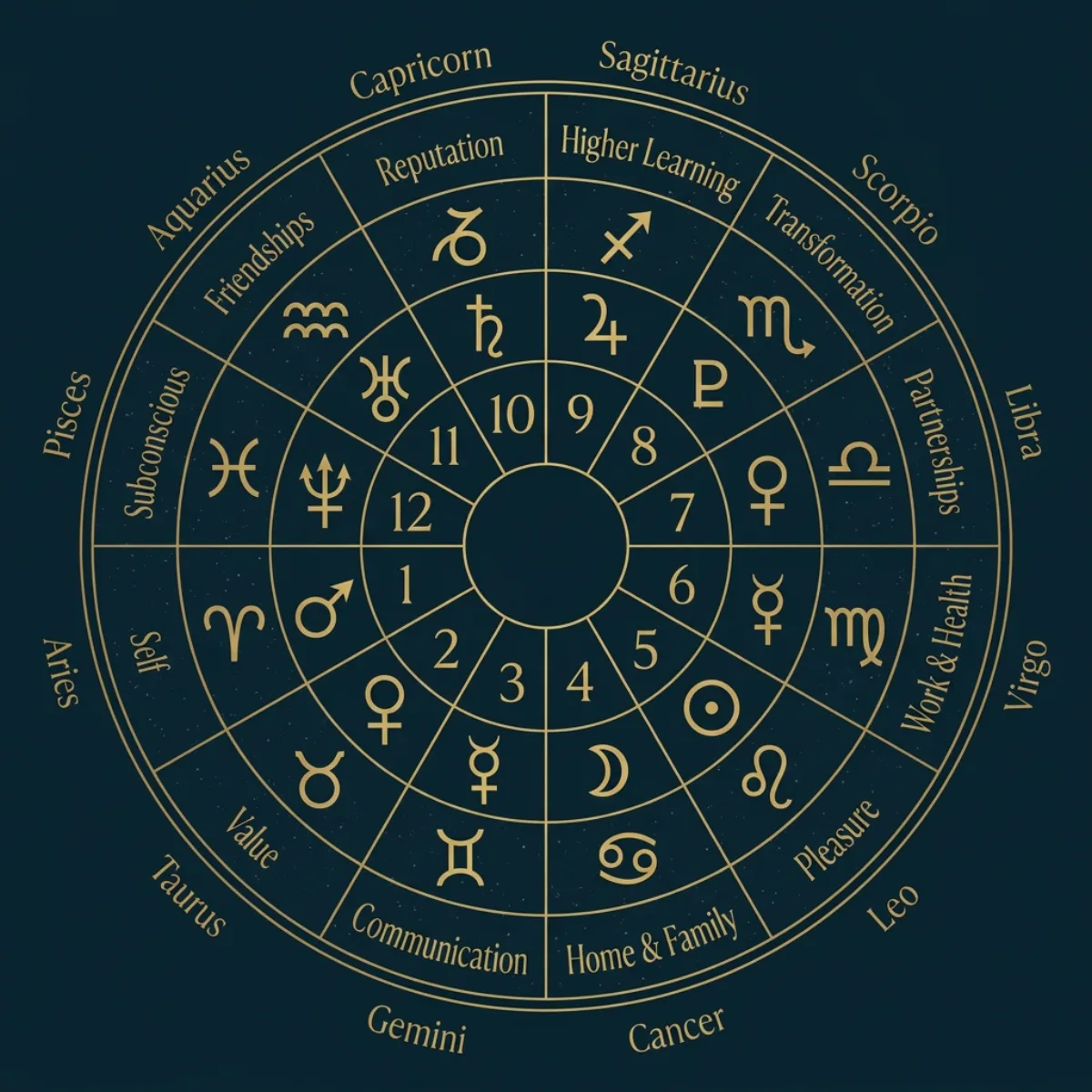
A sample birth chart with twelve houses, planets, and aspects A birth chart is dense. The trick is to read it in three passes, not all at once. Each pass tells you something different. By the third you have a real picture.
Pass one. The big three
Find your Sun, Moon, and Rising. The Sun is your core, the version of you the world meets. The Moon is your inner reflex, what you feel before you think. The Rising is the mask, how strangers read you in the first ten seconds. If you remember nothing else, remember these three. They give you most of the personality picture.
Pass two. Planets by house
Now look at where the other planets sit. The houses are twelve slices of the chart, each one a life area: self, money, communication, home, romance, work, partnership, depth, beliefs, career, friends, the inner world. A planet in a house tells you where in your life that planet's energy keeps showing up. Mars in your career house plays differently than Mars in your home house.
Pass three. The loudest aspects
Aspects are the angles between two planets. Some feel easy. Some feel like friction. You do not need to read every aspect in the chart. You need the loud ones. A Mars square Saturn explains why action feels heavy. A Venus trine Jupiter explains why love tends to come easily. The loud ones are the patterns you already half-know about yourself.
That is the whole method. Big three, planets by house, loudest aspects. You can read any chart with that order. Pick one line that lands. Sit with it for a week. That is the practice.
Appendix
Plain-word Glossary: Astrology Terms Explained
Quick definitions, in the same plain language.
Zodiac
The zodiac is an imaginary band of the sky divided into 12 sections, each named after a constellation. In astrology, the positions of the sun, moon, and planets across these 12 signs are believed to shape human personality, behavior, and destiny.
Sign / Sun sign
Where the Sun was on your birthday. The one people mean by "what is your sign."
Tropical vs sidereal
Two ways of fixing the zodiac. Tropical (used by Western astrology and most modern apps) is anchored to the seasons. Sidereal (used by Vedic / Indian astrology, applying the Lahiri ayanamsha — currently about 24°) is anchored to the actual stars. Naksha supports both — you pick when you start a reading. Your sign can differ by about one sign between them. Neither is wrong.
Ascendant / rising sign
The sign coming over the horizon when you were born. Needs an exact birth time.
Houses
Twelve slices of the chart, each a life area (self, money, home, work, and so on). Naksha uses Whole Sign in both Vedic and Western readings — it is the oldest house system and works correctly anywhere on Earth.
Aspects
The angles between two planets. Some feel easy. Some feel like friction.
Transits
Where the planets are today, compared to your fixed birth chart.
Birth chart
The whole snapshot. Every planet's position at your exact birth moment and place.
Ephemeris
The astronomy table and algorithm that gives exact planet positions. It is what computes your chart. No AI involved in this step.
Now do yours
Read your own chart.
You have read the theory. The most useful part is seeing it land on a real person. You.
Get started