
Vedic vs Western Astrology: Which One Should You Choose?
Two systems. Same sky. Different questions. Neither is wrong.
Published May 26, 2026 · Read time: 9 min · Astrology Education
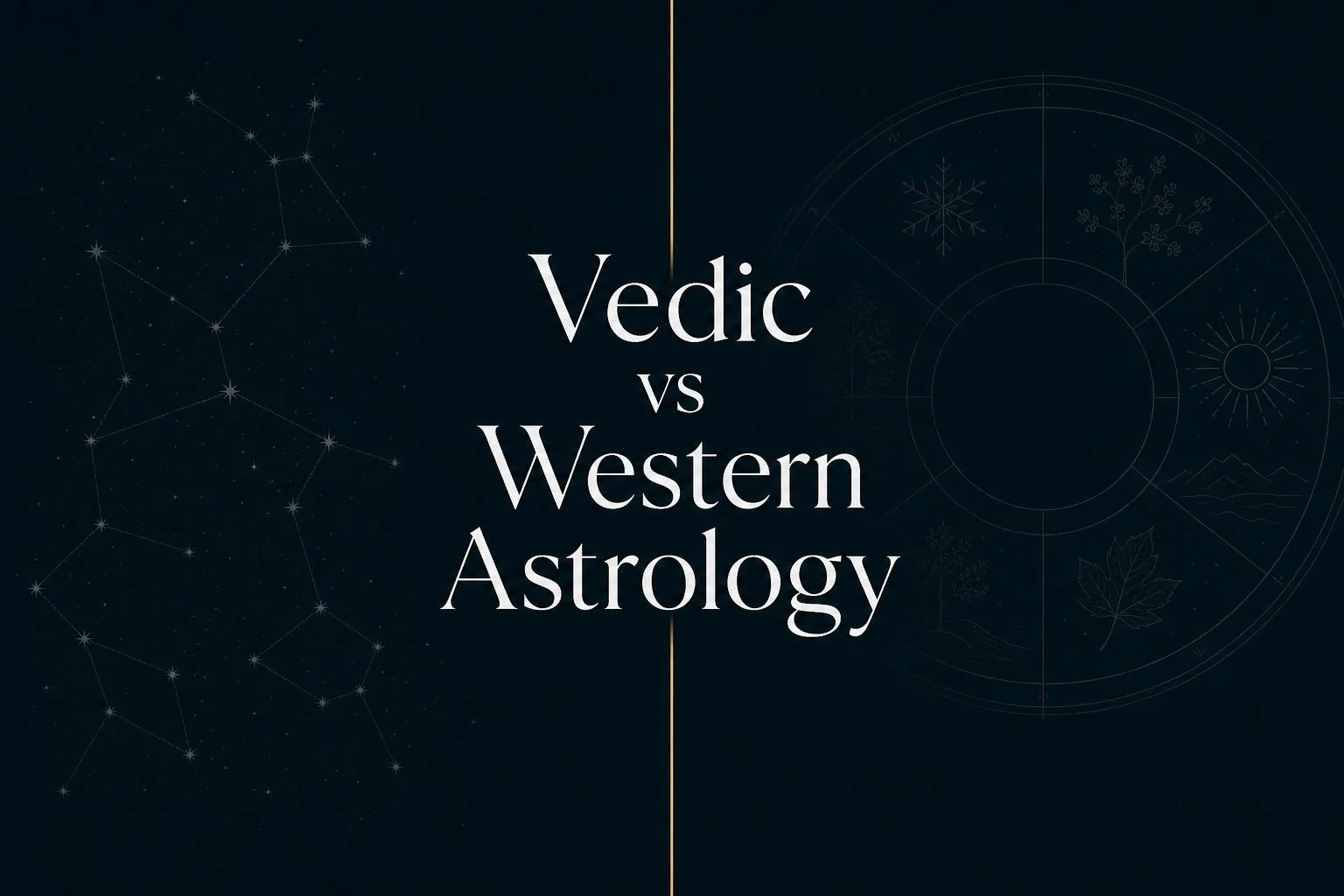
There are two main astrology systems alive today. Vedic, also called Jyotisha, and Western.
If you have ever been confused about your sign, this is probably why. Your Western sign, tropical, might be Aries. Your Vedic sign, sidereal, might be Pisces. Neither is wrong. They are just measuring different things.
Most astrology apps force you into one system. Naksha lets you choose both. But before you can choose, you need to understand what you are choosing between. For background, you can read our guide to the two main traditions.
The question is not "which one is right." It is "which one answers the question you are asking."
The History: Where These Systems Come From
Astrology goes back at least 4,000 years. The Mesopotamians were watching the sky and tracking patterns. The Indians, through the Vedas and the system of Jyotisha, were doing the same thing. The Greeks organized it into the twelve-sign zodiac. The Arabs preserved and expanded it through the medieval period. The Europeans took it back.
For thousands of years, there was one system: sidereal astrology. It was anchored to the actual stars in the sky.
Then, around the time of Ptolemy, about 2,000 years ago, Western astrologers made a choice. They decoupled the zodiac from the actual stars. Instead, they anchored it to the seasons. The spring equinox became the start of Aries, regardless of which constellation was actually behind the Sun on that day.
The Indians never made that choice. Jyotisha stayed sidereal, anchored to the actual stars.
For 2,000 years, the two systems have drifted apart because Earth wobbles on its axis. The stars have shifted about 24 degrees against the seasons. This is called the ayanamsa.
So today, two people born on the same day might have Western, tropical, Sun in Aries, and Vedic, sidereal, Sun in Pisces.
Same sky. Different systems. Different answers.
The Difference: What Gets Measured
This is the key to understanding both systems.
Vedic astrology, sidereal, measures: Where the planets actually are against the real stars right now.
The zodiac is pinned to constellations. Aries is always Aries, the constellation Aries, regardless of when the seasons happen to turn. When the Sun is in front of the constellation Aries, you have an Aries Sun. When it drifts into Pisces, you have a Pisces Sun.
This system is tied to the physical sky. It is verifiable. You can go outside and see where the stars are, and they match the astrology.
Western astrology, tropical, measures: The relationship between the planets and the seasons.
The zodiac is pinned to the spring equinox. The moment the spring equinox happens, that is the start of Aries. The Sun could be in front of the constellation Pisces, but if it is the spring equinox, it is an Aries Sun in Western astrology.
This system is tied to the rhythm of the year. It is symbolic. It connects the planets to human life through the cycle of seasons. Spring, new growth, new beginnings. Summer, expansion. Autumn, harvest. Winter, rest.
Neither system is measuring the wrong thing. They are measuring different things.
The Practical Difference: What It Means for Readings
The two systems do not just give you different signs. They give you different information.
Vedic astrology leans toward timing and life phase.
Because Vedic is sidereal, anchored to the actual stars, it is deeply concerned with exact positioning. Where is the planet right now? How far has it moved? Is it speeding up or slowing down?
This makes Vedic astrology very good at answering timing questions. When will this happen? What life phase am I in? When should I start something?
Vedic astrology is woven into Indian daily life. Wedding dates are chosen based on Vedic astrology. Business launches are timed based on Vedic astrology. Baby names are given based on Vedic astrology. The system is designed for timing.
It is also very technical. Vedic astrology has more tools and techniques. More house systems. More calculation methods. It is deeper and more precise, but it is also more complex.
Western astrology leans toward psychology and identity.
Because Western is tropical, anchored to seasons, it is deeply concerned with the rhythm of the year and the cycle of life. It connects the planets to human psychology through the cycle of seasons.
This makes Western astrology very good at answering identity questions. Who am I? Why do I react the way I do? How do I relate to people?
Western astrology thinks in terms of archetypal psychology. Each sign and planet represents a psychological archetype. Your chart is a map of your psyche.
It is also simpler. Western astrology has fewer techniques and calculations, but the ones it has are powerful and clear. It is easier to learn and use.
The Practical Consequence: Your Sign Can Be Different
This is the part that confuses people.
If you were born on April 15, your Western Sun is probably in Aries, spring equinox equals start of Aries. But your Vedic Sun might be in Pisces, because the actual constellation Aries has drifted about 24 degrees away from where it was 2,000 years ago.
Neither is wrong. The Western system is saying "the Sun is at the spring equinox, so you are an Aries psychologically, connected to new growth and beginnings." The Vedic system is saying "the Sun is in front of the constellation Pisces, so you are a Pisces astrologically, with the timing and life-phase characteristics of Pisces."
Same person. Same sky. Different question. Different answer.
This is also why people often feel more connected to one system than another. If Western astrology says you are a Leo but you do not feel like a Leo, try Vedic and you might be a Cancer. Sometimes your sign in one system resonates more than your sign in the other.
Which System Should You Use?
The honest answer is: pick the one that resonates with you.
Use Western astrology if:
You are interested in psychology and identity. You want to understand why you react the way you do. You relate to the Western zodiac sign you already know, "I am a Taurus" resonates. You want a simpler, more accessible system. You live outside of India and the Western system is your cultural reference.
Use Vedic astrology if:
You are interested in timing and life phases. You want to know when things will happen and what phase you are in. You grew up with Vedic astrology or your family uses it. You relate to the Vedic sign more than the Western sign. You want a more technical, deeper system.
Use both if:
You are curious about the difference. You want to see how both systems read your chart. You want to answer both psychology questions and timing questions.
There is no "right" choice. There is only the choice that answers the question you are asking.
Naksha Supports Both
Most astrology apps force you into one system. Naksha lets you choose.
When you generate a reading on Naksha, you pick one of two options.
Vedic, sidereal, Lahiri ayanamsha. The system used in India for thousands of years, anchored to the actual stars.
Western, tropical. The system used by most modern apps and horoscopes, anchored to the seasons.
Both run on the same birth details, the same computed chart, and the same AI for the explanation. Both use Whole Sign houses, the oldest house system, used essentially unchanged for 2,000 years, because it works correctly anywhere on Earth.
The only thing that changes is the zodiac anchor. That one choice ripples through the entire reading. Your Sun sign might be different. Your Moon sign might be different. Your planets might be in different houses, because the houses are relative to where your rising sign lands.
Everything else stays the same: your planetary positions relative to each other, your aspects, the core themes of your chart. If you want to dig in, read our guide to the pieces of your chart.
How to Think About This
Here is the mental model that helps.
Think of your birth chart as a fixed snapshot of the sky. The planets were where they were. That is not changing.
But there are two ways to measure that snapshot.
Vedic measures it against the actual stars. "Your Sun is 24 degrees past the actual constellation Aries."
Western measures it against the seasons. "Your Sun is at the spring equinox point, so you are an Aries."
Both measurements are describing the same sky. They are just using different reference points. It is like describing a location by latitude/longitude versus by nearest city. Both are correct. They are just using different systems.
The sky does not change. Your chart does not change. But which interpretation of the chart you read depends on which system you choose.
What This Means for You
If you have ever been confused about your sign, or felt like one sign fits you better than another, this is probably why.
You might be a Western Aries and a Vedic Pisces. You might feel more like the Pisces, intuitive, dreamy, fluid, than the Aries, bold, direct, pioneering. That is not a contradiction. That is just two different systems reading the same sky.
When you choose a system, you are not choosing truth. You are choosing the question you want the system to answer.
Vedic asks: When. What phase. Timing questions.
Western asks: Who am I. Why. Identity questions.
Both are valid. Both are useful. The question is which one matters more to you right now.
Or read the full guide → if you want more context
Related articles
Why a Computed Chart Actually Matters
Most astrology apps guess. Naksha computes. Here is why that difference is everything.
How an AI Reads Astrology (Without Being Psychic)
AI is not psychic. It translates. Here is how Naksha uses AI to interpret your real computed chart.
Why You Can't Read Your Birth Chart From a Diagram
Birth chart wheels are real astrology, but unreadable notation. Here is why Naksha translates instead.